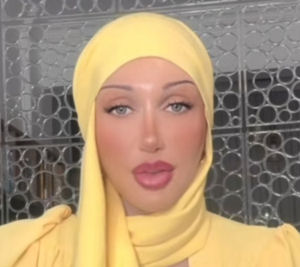
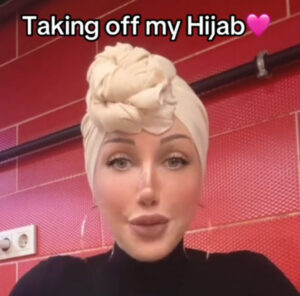
 Oh, Jamila Fair – Frankfurt’s most desperately performative “dawah” queen, still grinding for clout with reels that twist Islam into her personal grudge match. Her comically surgically enhanced face, with those lingering effects of past fillers in cheeks, chin, and lips (which she partially removed after “constant bullying” but not fully enough to escape the stiffness), and that overly pointed, sharpened nose standing out awkwardly in profiles, remains a glaring hypocrisy against her modesty lectures and warnings about altering Allah’s creation. Yet the fixation on appearance pales next to the core academic demolition she’s faced across platforms: her smug dismissal of authentic hadith adherence as “hadith worship,” a phrase she deploys repeatedly with eye-rolling condescension like “I love to debate hadith worshippers with their own beliefs🫠😅” and claims that women “are indeed not allowed to feel, think or speak according to hadith worshippers. They have to obey.”
This isn’t fringe critique – it’s the most viral, sustained refutation hammering her from dawah circles, YouTube exposés (including Ali Dawah’s direct call-outs like “AYAS VOICE AND JAMILA FAIR EXPOSED BY ALI DAWAH”), Reddit threads in progressive and hijabi spaces, and broader Muslim online discourse. The takedown is brutally straightforward and evidence-based.
Her Core Claim Exposed as Ignorant Projection: She frames strict Sunnah adherence as idolatrous “worship” of hadith over Quran, implying hadith narrators and traditional scholars elevate narrations above divine revelation. Yet this is classic strawman – Islam’s foundations require both Quran and Sunnah as inseparable sources, per the Prophet’s (ﷺ) explicit command: “Hold fast to my Sunnah and the Sunnah of the Rightly-Guided Caliphs” (Sahih al-Tirmidhi). Scholars from the Salaf to today (Ibn Hajar, al-Albani, contemporary institutions like Yaqeen) defend rigorous authentication precisely to safeguard against fabrication, not to “worship” texts. Her slur reduces centuries of science of hadith methodology to fanaticism, revealing zero engagement with actual scholarship – she’s debating a caricature she invented for reels.
Viral Dawah Responses Lay It Bare: Ali Dawah and allied creators have dissected this in videos, pointing out how her rhetoric mirrors modern Quran-only revisionism that cherry-picks when convenient (e.g., accepting certain hadith on modesty while sneering at others on obedience or gender roles). Threads highlight her hypocrisy: she mocks “hadith worshippers” for allegedly silencing women, yet her own content fixates on controlling narratives around female behaviour, awrah, and “dawah bros'” supposed obsessions. The irony is thick – accusing others of blind obedience while demanding agreement with her selective takes.
Broader Fitnah Pattern: This ties into her casual mockery like “group takfir parties in Ramadan” (trivializing grave creedal matters in the sacred month) and obsessive highlights (“Jam&theDawhBros”) dissecting figures like Ali Dawah or Nassy, ranting about men focusing “on what we have between our legs” while building content around their “obsessions.” Psychoanalytically, it’s projection deluxe: a desperate bid for relevance in male-dominated dawah spaces, using Islam to mask clout-chasing and unresolved craving for validation she publicly critiques
From an Islamic perspective, this is deviant nonsense dressed as enlightenment. Dismissing authentic hadith methodology as “worship” echoes historical heresies the ummah refuted long ago – Mu’tazila-style rationalism that prioritizes personal comfort over transmitted knowledge. It sows division, violates commands against mockery (Surah Al-Hujurat), and ignores that true tawhid includes submission to the Sunnah. The ummah’s response – viral exposés, scholarly-adjacent takedowns – brands it fitnah, not truth. If “every truth I speak is from ALLAH,” why does it reek of ego, inconsistency, and intellectual laziness?
From a feminist perspective, it’s pathetically self-sabotaging: she claims to liberate women from “hadith worshippers” restricting their thoughts/speech, yet her output reduces sisters to binary roles, body-shames indirectly while defending her own enhancements as “unique beauty,” and sexualizes the dawah men she accuses of objectification. Her motives scream desperation – convert-era insecurity fuelling controversy farming, projecting onto “dawah bros” while orbiting them for engagement. Viral critiques nail her as performative: fighting “oppression” by reinforcing the gaze she pretends to reject.
Log off, Jamila. The platforms have roasted your “hadith worshippers” trope as the amateurish dodge it is; scholars and dawah heavyweights have buried it under evidence. Your “truths” are just loud cries for attention in a faith you treat like content fodder. Ouch.